· ReadyStack
Worked example
Real numbers from this tool, line by line.
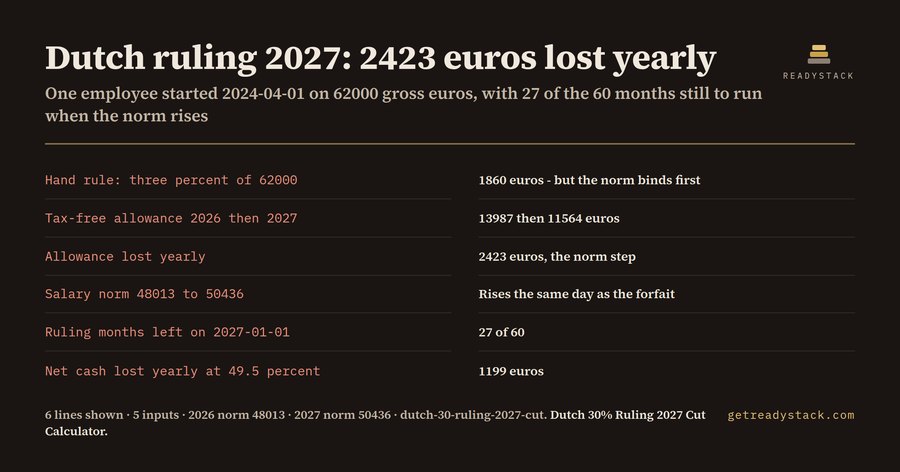
A Dutch payroll manager in Amsterdam recalculated one 2024 expat hire and found 2423 euros of tax-free allowance gone on 2027-01-01, not the 1860 that three percent of a 62000 euro salary would suggest.
Two changes, one day
On 1 January 2027 two separate things change for every incoming employee in the Netherlands whose 30%-ruling was first applied on or after 1 January 2024. The forfait falls from 30 percent to 27 percent. And the general salary norm rises from 48013 euros, the 2026 figure, to 50436 euros. For employees under 30 with a Dutch master degree the norm goes from 36497 to 38338 euros.
Rulings already running before 2024 are covered by the Belastingplan 2025 transitional law. They keep 30 percent and the old indexed salary norms for their whole term. So the first thing any recalculation has to do is look at the start date, not the salary.
Why the answer is not three percent
The tax-free allowance is the lower of two numbers: the forfait taken over the wage capped at the WNT norm, 262000 euros in 2026 and up from 246000 in 2025, and gross salary minus the salary norm. The second one is what most employers actually pay, because it is smaller.
Below roughly 69000 euros gross salary the norm is the binding rule. And when the norm binds, the loss on 2027-01-01 is exactly the norm step: 50436 minus 48013, which is 2423 euros. It does not scale with salary at all.
Here is the default case shipped with the calculator. An employee started on 2024-04-01, earns 62000 euros gross including the allowance, standard norm, 49.5 percent marginal rate. In 2026 the allowance is 13987 euros. From 2027 it is 11564 euros. That is 2423 euros lost yearly, 1199 euros of net cash a year, and on 2027-01-01 there are 27 of the 60 months of the term still to run, so 2698 euros of net cash over what is left.
Now move one input. At 90000 euros gross the forfait binds instead: 27000 euros becomes 24300, exactly three percent, 2700 euros lost yearly. Move the start date back to 2023-05-01 and the transitional law takes over: 30 percent stays and nothing is lost, though only 16 months of the term remain.
Three employees, three different answers, from the same five inputs.
What the calculator does
It is a browser popup, so it sits next to the payroll tab. Five inputs: the first day of the ruling, gross annual salary including the allowance, which salary norm applies, the employee marginal income tax rate, and how many employees share the profile. Eight outputs: the 2027 forfait percentage, the 2026 allowance, the 2027 allowance, allowance lost yearly, which rule binds, net cash lost yearly, months left on 2027-01-01, and net cash lost over the rest of the term.
All of that is free, for one employee, with no licence key and no limit. The same calculation also runs as a plain web page with nothing installed.
Where the paid key starts
A different job, not a bigger version of the same one. The key exports your whole expat register to CSV, each employee with their 2027 allowance, binding rule and term end date, and sets a browser alarm before each ruling cliff. 60 dollars once, one licence key per person or team seat. For scale: a Dutch tax adviser bills 80 to 180 euros an hour, about 145 on average in 2026, and one careful recalculation of a single ruling is roughly an hour.
Sources: Belastingdienst 2026 figures for the salary norms and the WNT cap, Belastingplan 2025 for the 27 percent forfait, the 2027 norms and the transitional law.
Questions people ask
What does this calculator actually do?
It takes five inputs - the first day of the ruling, gross annual salary, which salary norm applies, the employee marginal tax rate and how many employees share the profile - and returns eight values: the 2027 forfait percentage, the 2026 allowance, the 2027 allowance, allowance lost yearly, which rule binds, net cash lost yearly, months left on 2027-01-01 and net cash lost over the rest of the term.
Who is it for?
Payroll and HR staff at Dutch employers who run international hires through AFAS, Nmbrs or Personio in a browser tab, and the expat employees themselves. It is built for the person who has to answer, before the January 2027 payroll run, what each ruling is worth next year.
Why will a free chatbot not do this?
Because the loss is usually not 3 percent. The allowance is the lower of the forfait and gross salary minus the salary norm, and both change on the same day. Below roughly 69000 euros gross the norm binds, so the real loss is the 2423 euro norm step. Chatbots quote the headline percentage and the 2025 norm.
What is free and what needs the key?
Free is the entire calculation for one employee, unlimited, with no key: all five inputs and all eight outputs. The 60 dollar key adds a different axis - CSV export of your whole expat register with each employee's 2027 allowance, binding rule and term end date, plus browser alarms before each ruling cliff.
What would this cost from a person?
A Dutch tax adviser bills 80 to 180 euros an hour, with a 2026 average of about 145 for a self-employed adviser. Recalculating one ruling by hand, checking the transitional rule and the two norms, is roughly an hour per employee. Twenty expats is twenty of those hours.
Ask about this tool
One question, answered by the person who built it. Your email only if you want the answer sent.